Voyeurism and the window motif
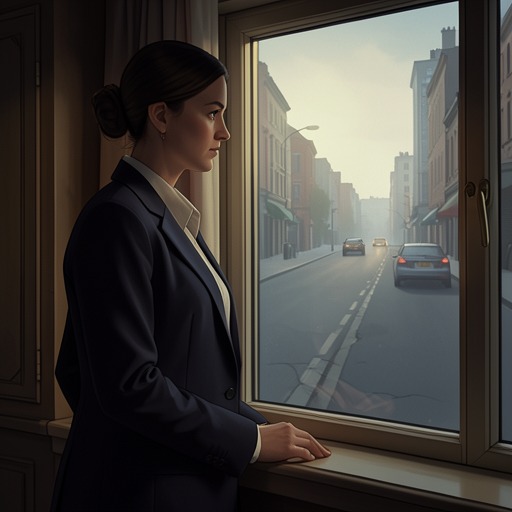
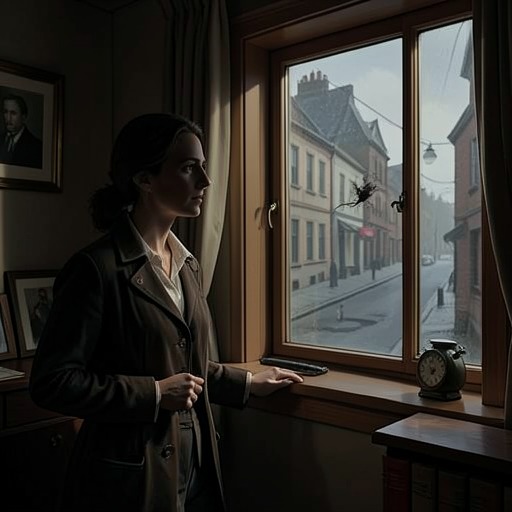
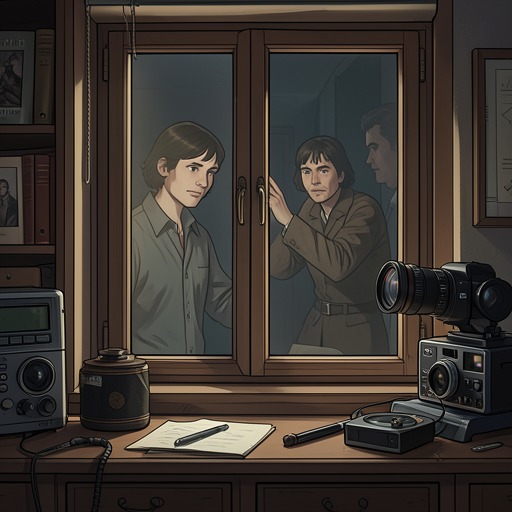
The Woman in the WindowVoyeurism and the window motif organize Anna Fox’s uneasy passage between watching other people and being watched herself. Through windows, the Russell household becomes a sequence of framed images that Anna interprets, revises, and sometimes recognizes as shaped by her own loneliness and expectations. The motif links cinematic spectatorship to the limits of perception: seeing can feel like knowledge, but a frame may conceal as much as it reveals.
Cinema and imagined scenes
Anna Fox explicitly understands one night’s vision through the conventions of older thrillers. She associates what she saw with Rear Window, Body Double, and Blow-Up, and describes the experience as resembling a compilation of films about people who watch others. These references make spectatorship part of the episode’s meaning: the view from a window does not arrive as neutral evidence but as an image already organized by familiar stories about suspense, observation, and danger.
The distinction between an image and an event sharpens when Anna recognizes that she saw a killing without a killer or a victim, an empty sitting room and an unoccupied sofa. She acknowledges that the scene was what she wanted and needed to see. The discrepancy between the force of her perception and the absence of a visible event makes the window’s apparent clarity deceptive. It supplies a scene, but not necessarily the facts needed to establish what happened.
Anna’s reflection on loneliness gives that imagined scene an emotional context without making it reliable evidence. Recalling an exchange between Bogey and Bacall, she contrasts the idea of being born lonely with her sense that loneliness was made for her. The memory shifts attention from the supposed action outside to the observer’s own condition. The window is therefore both an opening onto other people and a screen onto which Anna’s isolation can be projected.
The Russell household as a frame
On Tuesday, November 9, Anna wakes in darkness and returns to a view of the Russell house, whose lit rooms appear like a dollhouse. From her position, she can distinguish Ethan Russell at his computer, Alistair Russell preparing food in the kitchen, and a woman Anna tentatively identifies as Jane Russell on the striped loveseat, holding a phone. The separate rooms and small visible actions make the house resemble a set of staged interiors. Anna can see people at a distance, but her view gives her no direct access to what they are doing or thinking.
That limitation matters because Anna’s descriptions move between observation and conjecture. She sees the phone in Jane Russell’s hand, then speculates about whether she is looking at family photographs, playing a game, or updating friends. The possibilities are not presented as confirmed facts; they reveal the interpretive work Anna performs to fill the distance between the window and the room. When her throat tightens, she closes her curtains and remains alone in the dark, frightened and longing. Watching has offered proximity without connection, and she responds by shutting off the view.
Watching and being watched
At another window, Anna initially experiences darkness as protection. Looking toward the Russell house, she sees Alistair Russell and Jane Russell talking in the kitchen; he holds a laptop while she folds her arms. Anna thinks of herself as safe and secret in her dark study, and imagines that they might look back. The scene makes the presumed one-way gaze unstable: her sense of concealment depends on believing that the observers in the lit house cannot see her as clearly as she sees them.
Then Anna notices Ethan Russell at his upstairs window. He appears as a narrow shadow against the light behind him, presses both hands to the glass, and waves. The gesture makes him a visible watcher within the same composition. Anna is not simply outside the household’s visual world, looking in; she is also an image that someone inside may see. The window motif thus reverses the positions of spectator and spectacle, unsettling the secrecy she had taken for safety.
Replaying and recognizing
When Anna tries to redirect her thoughts, she mentally rewinds through a conversation with Bina, Ethan Russell at his window, a film, and visits from the detectives, David, Alistair Russell, and Ethan Russell. The sequence runs backward past the coffee shop and hospital to the night she watched the woman she knew as Jane Russell die, then returns to the woman turning from the sink to face her. Anna’s recollection takes the form of editing and projection: the camera seems to leap from the floor to her hands as the remembered scene is rewound. The cinematic language connects her acts of looking to the way memory selects and rearranges images.
A photograph later provides a more concrete reminder of the connection between observation and the observer. Anna recognizes a sunset image she took from the kitchen window: distant buildings cut into the orange sky, a bird is fixed in flight, and the street is lit by the setting sun. Reflected in the glass is the woman Anna knew as Jane Russell. The image makes the window both a viewpoint and a reflective surface; it records the outside scene while also placing the observer’s chosen subject within a visible frame. Anna subsequently asserts that Jane Russell was real, and, seeing Alistair Russell and his wife together in the parlor, calls them liars. The photograph and the renewed view of the couple give the motif a role in her reconsideration of what she witnessed, rather than reducing every window image to either truth or fantasy.
Significance of the motif
Across these scenes, windows regulate what Anna can know and how close she can feel to other people. They permit careful visual attention while keeping the observer physically apart; curtains can end the view, darkness can seem to offer cover, and glass can return the watcher’s image. The Russell house becomes legible in fragments, through rooms and gestures that Anna must interpret from outside.
The repeated frames also bind voyeurism to cinema and memory. Anna recognizes thriller conventions in her own perceptions, replays events as if editing film, and encounters a photograph that preserves both a sunset and a reflection. These forms of looking make observation active rather than transparent: each image is selected, framed, and interpreted. The motif’s decisive tension is that watching promises access to hidden lives while exposing how little a view alone can settle. Its movement from imagined scene, to reciprocal gaze, to photographic recognition tracks Anna’s changing relation to what she sees and to the possibility that she, too, is visible.